
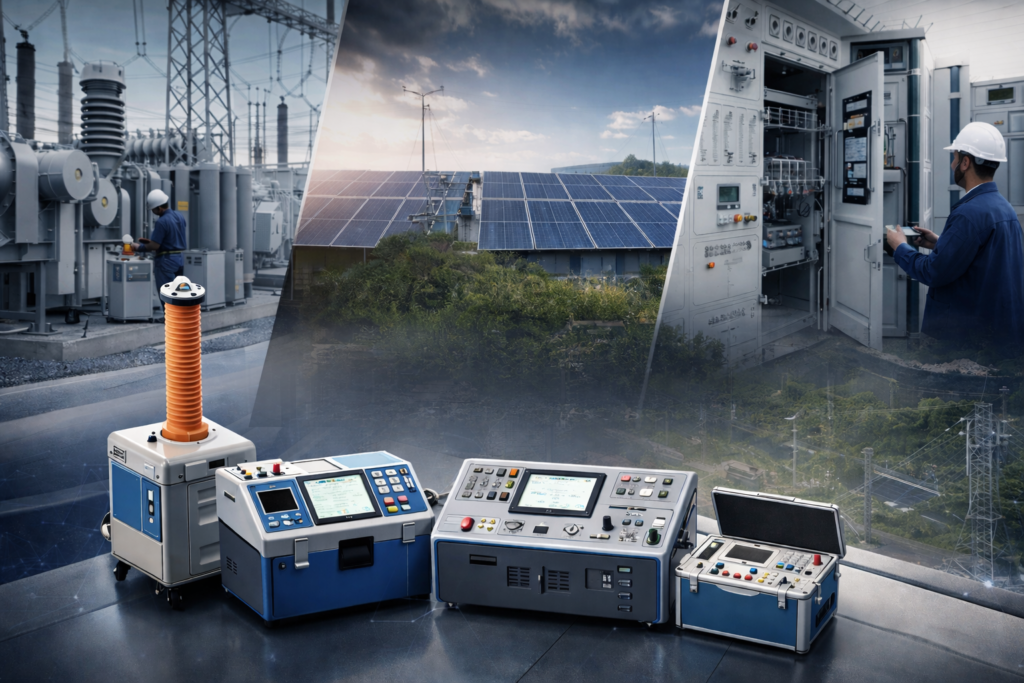
In power engineering projects, on-site testing is a critical activity throughout the entire lifecycle of electrical systems, from installation and commissioning to operation, maintenance, and fault analysis. The selection and application of appropriate testing equipment directly affect system safety, commissioning quality, and long-term reliability.
This article provides a practical overview of commonly used testing equipment in power engineering sites, with a focus on both primary system testing and secondary system testing, based on real-world engineering scenarios.
1. Overview of On-Site Testing in Power Engineering
On-site testing in power engineering projects is typically conducted during the following stages:
• Acceptance testing before commissioning
• Periodic inspection during normal operation
• On-site troubleshooting and fault diagnosis
These activities are usually performed in substations, power plants, or renewable energy sites, often under tight outage schedules and strict safety requirements. As a result, testing equipment must offer high reliability, strong safety protection, and good adaptability to field environments.
2. Primary System Testing Equipment
The primary system includes high-voltage electrical equipment such as transformers, circuit breakers, cables, busbars, and insulators. Primary system testing focuses on verifying insulation performance, electrical characteristics, and the overall condition of the equipment.
2.1 High-Voltage Testing Equipment
High-voltage testing equipment is used to assess insulation strength and dielectric performance of primary equipment. Commonly used devices include:
• AC withstand voltage test sets
• DC high-voltage generators
• Resonant test systems
• Partial discharge testing instruments
These devices are widely applied in transformer testing, cable testing, and insulation verification during both commissioning and maintenance stages.
2.2 Transformer Testing Equipment
Transformer testing is a key part of primary system verification. Typical transformer testing equipment includes:
• Transformer turns ratio testers
• Winding resistance testers
• Insulation resistance testers
• Dielectric loss (tan delta) testers
These instruments help engineers evaluate transformer condition, identify installation or manufacturing issues, and support condition-based maintenance decisions.
2.3 Primary Equipment and Circuit Testing Instruments
To verify current-carrying performance and mechanical condition of primary equipment, engineers commonly use:
• Contact resistance testers
• Circuit breaker timing analyzers
• Loop resistance testers
Such tests ensure reliable current paths and correct mechanical operation under actual service conditions.
3. Secondary System Testing Equipment
The secondary system consists of relay protection devices, measurement and control equipment, and secondary circuits. Testing of the secondary system focuses on functional correctness, coordination, and reliability.
3.1 Relay Protection Testing Equipment
Relay protection testing equipment is essential for verifying protection logic, setting values, and response times. Typical relay protection test sets support:
• Overcurrent protection testing
• Distance protection testing
• Differential protection testing
• Voltage and frequency protection testing
• End-to-end testing for communication-based protection
These devices are widely used during commissioning, routine testing, and post-fault analysis.
3.2 Secondary Circuit and Wiring Testing Equipment
To ensure correctness of secondary wiring and signal transmission, engineers commonly use:
• Secondary circuit testers
• Wiring continuity testers
• Polarity and phase sequence testers
These tools help identify wiring errors, incorrect connections, and signal issues before system energization.
3.3 Measurement and Recording Devices
Accurate measurement and data recording are essential for analysis and reporting. Commonly used devices include:
• Power quality analyzers
• Digital fault recorders
• Portable data acquisition systems
The recorded data is often used for commissioning documentation, compliance verification, and technical evaluation.
4. Key Considerations for Equipment Selection
When selecting testing equipment for power engineering sites, engineers typically focus on the following factors:
• Compliance with applicable technical standards
• Suitability for real field operating conditions
• Safety performance and protection mechanisms
• Stability and repeatability of test results
• Ease of operation and clarity of test data and reports
In project-based procurement processes, testing equipment is usually evaluated based on technical performance, application experience, and long-term service support.
5. Conclusion
On-site testing is an indispensable part of power engineering projects. From primary system insulation verification to secondary system protection and circuit testing, reliable testing equipment plays a vital role in ensuring safe and stable operation of power systems.
A clear understanding of commonly used testing equipment and their application scenarios helps engineers make informed decisions during equipment selection, testing execution, and project delivery. As power systems continue to evolve, on-site testing equipment will remain a fundamental technical foundation supporting modern power networks.